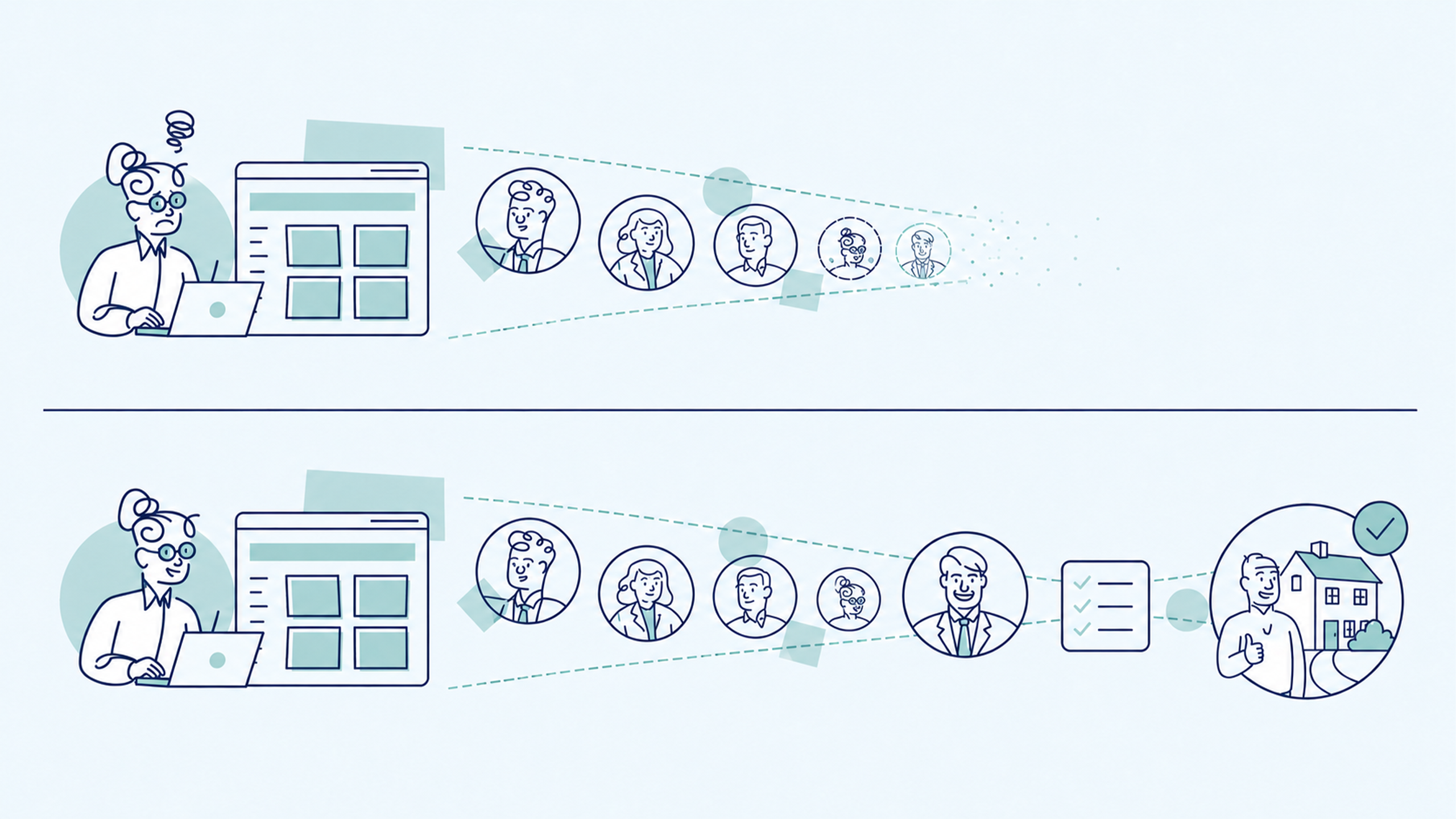


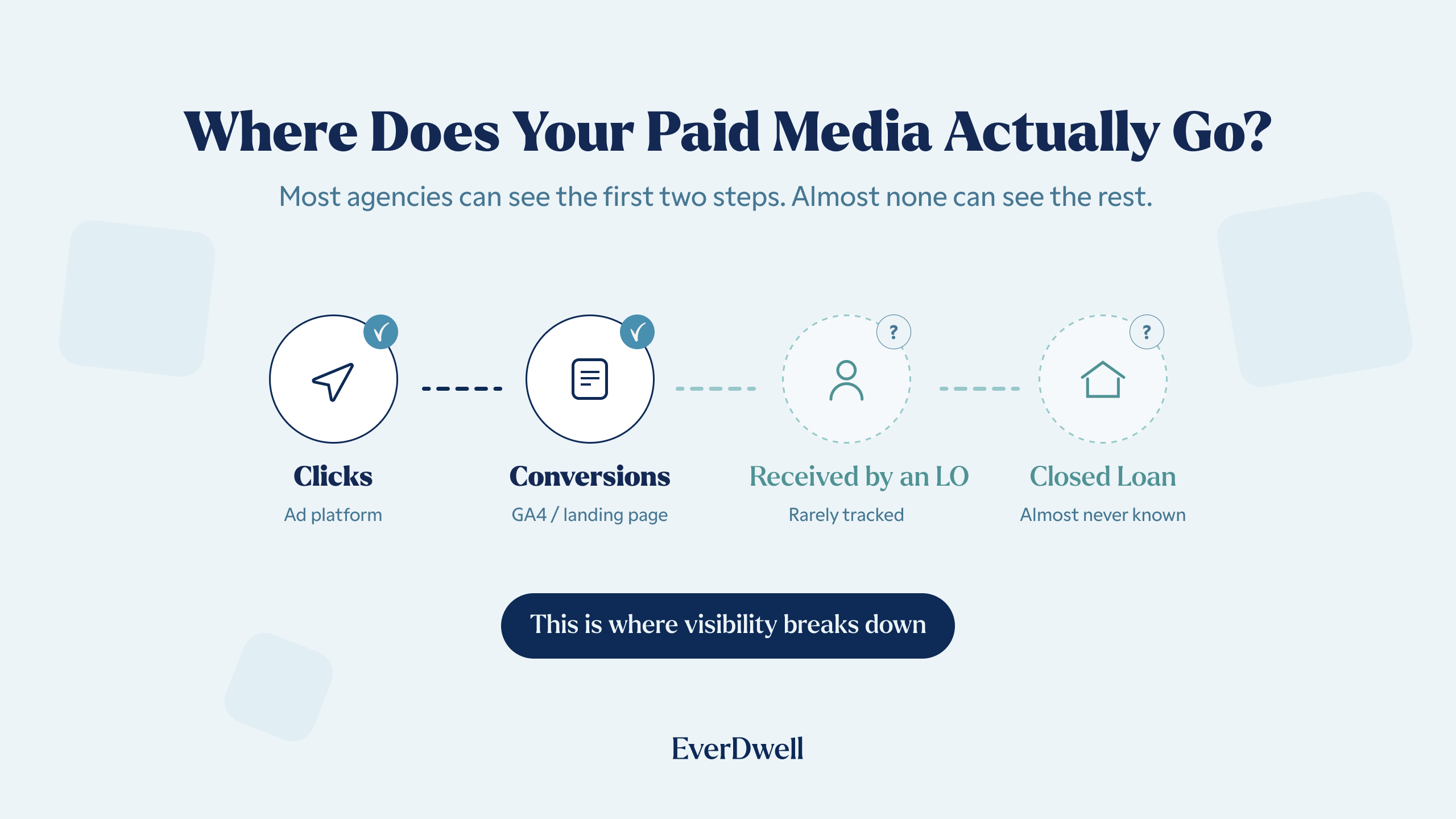
Ask any HFA how many clicks their last campaign got, and you’ll get an answer fast. Ask how many of those clicks turned into a form fill, and some can pull that up too. GA4 has it. It’s right there.
Now ask how many of those form fills turned into a lead a loan officer actually received.
That’s usually where the answer stops.
The reality is: for a lot of agencies, it’s not that the number is hard to find. It’s that the number doesn’t exist yet. Nobody’s tracking whether a form fill ever became something a loan officer worked, which means the next question, how many of those leads closed, was never really answerable to begin with. It’s hard to measure a connection that was never made.
The gap starts earlier than you’d think
This isn’t a case of anyone dropping the ball. It’s more that the systems were never wired together in the first place, and that shows up in stages. Your ad platform reports clicks. GA4 reports conversions. But the handoff from “someone filled out a form” to “a loan officer has this lead” usually doesn’t have a system behind it. It’s assumed to happen rather than tracked as happening, and once that handoff is invisible, everything after it, follow-up, applications, closings, becomes invisible too.
The lead doesn’t disappear. The HFA’s ability to know what happens to it does.
Run this checklist
Before your next budget conversation, be honest about how many of these you can actually answer:
- Do you know how many of your form fills became a lead a loan officer received, not just how many people converted on your landing page?
- Could you trace a specific closed loan back to the campaign that generated it?
- If your conversion rate went up but closings didn’t, would you catch it, or would it read as a win?
- Do you know which channels send loan officers leads worth working, versus leads that just look good in a report?
- If someone questioned your paid media budget tomorrow, would you have data, or a shrug?
If most of these gave you pause, you’re in good company. For a lot of HFAs, the honest answer to the first one is “we genuinely don’t know,” and that’s a completely normal place to be starting from.
What if you’re running traditional media too?
Radio, print, direct mail, none of that comes with a click or a form fill, so the checklist above only tells half the story if traditional channels are part of your mix.
The closest thing agencies have to a proxy is comparing closed loan volume in a campaign’s target zip codes before and after it ran, often looking six to twelve months out on each side, a fairly dependable signal. If closings tick up in the right area while your campaign is live, that’s worth paying attention to.
It’s just not the whole picture. It won’t tell you for certain whether it was your campaign, a rate drop, a competitor’s promotion, or the market moving on its own. You’ll see that something shifted. You won’t always know exactly what shifted it, and that’s okay; it just means this piece of the puzzle needs a little more context around it.
Worth naming honestly: traditional media’s visibility gap tends to be even wider than digital’s. A digital lead at least leaves a form fill and a timestamp somewhere. Traditional media often doesn’t leave you quite as much to work with.
What not knowing actually costs you
It’s more than just inefficiency. A campaign, digital or traditional, can look like it’s working for months while quietly producing less than the spend deserves, and it’s easy for that to go unnoticed, because the number everyone’s watching (clicks, conversions, a zip code uptick) was never telling the whole story to begin with.
And at some point, someone’s going to ask the harder question. Your Executive Director, a finance office, a board, whoever signs off on your budget, will want to know what the money actually produced. “We don’t track that” is a much harder answer to give than almost any real number, even a modest one. Being able to answer matters just as much as what the answer turns out to be.
Closing the gap
Here’s what the agencies who can answer these questions have in common: visibility that runs from the moment someone becomes a lead all the way to the moment a loan closes, no matter which channel brought them in. That doesn’t solve attribution. Digital and traditional media will always carry some amount of directional guesswork about what drove what. But it does solve the part of the black box you can actually fix: knowing whether the leads you’re generating go anywhere at all.
That’s not a marketing problem. It’s an infrastructure problem, and solving it means being able to trace a lead all the way to a family in a home, whether it started with a click or a billboard.
That’s the kind of support EverDwell is built to provide. Not a replacement for your marketing strategy, and not the reason your campaigns work. Just the reliable partner making sure you can see what your spend is actually producing. (And if you’d rather hand off the campaigns themselves, that’s something we help plan and place for HFAs too, so the visibility and the media can come from the same place.)
If this sounds like your agency, we’d be glad to walk you through how EverDwell closes that gap. Book a free demo today to see it in action.